LOLER 1998 and Crane Scales: The Complete UK Compliance Guide
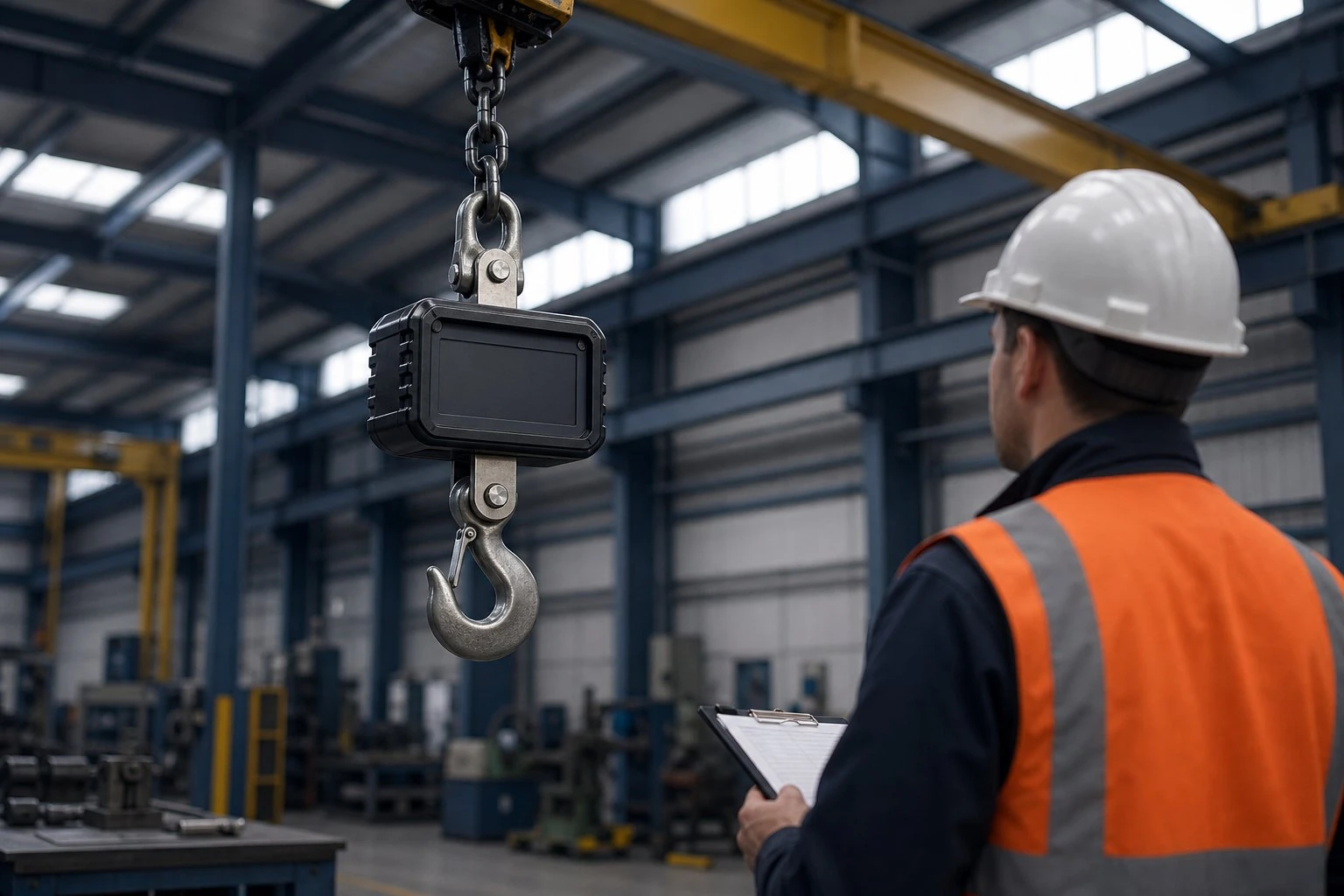
Does a crane scale need a LOLER thorough examination? Six-month intervals, record rules and a free register template, based on HSE and LEEA guidance.
Under LOLER 1998, lifting accessories must receive a thorough examination by a competent person at least every six months, or at intervals set by a written examination scheme. Industry guidance treats a crane scale hung between the hook and the load as part of the lifting chain, so most UK duty holders examine it on the six-month cycle.
That single paragraph answers the question most buyers arrive with. The rest of this guide explains where those duties come from, how a crane scale fits into them, what your records must contain, and how to set up a simple register that will satisfy an auditor — with links to the official sources so you can verify every claim yourself.
Home › Guides › LOLER compliance — this page is the hub for our LOLER cluster. Everything below is organised so you can read this page alone, or drop into the specific guide your situation needs.
The LOLER library: every guide in this cluster
Duties and records — what a thorough examination report must contain, written examination schemes and when 6/12 months are not the rule, what happens if your examination is overdue, and why your insurer asks for examination reports.
Scope questions — LOLER or PUWER: which rules cover your workshop kit, does a crane scale need its own examination when rigged with a hoist, and the second-hand equipment examination trap.
Seasonal routines — the year-end register audit before January shutdown and the January restart checklist.
Live regulatory watch — HSE’s LOLER review: what could change and the rolling review status tracker. HSE completed a Call for Evidence on LOLER 1998 in November 2025; the outcome is expected during 2026 and had not been published at the time of writing. Current rules remain fully in force. We update this hub and every guide above within 48 hours of any announcement.
Working tools — the examination due-date planner, the WLL calculator, and the free examination register template (CSV and printable PDF). Some guides and tools publish across 2026-27; links activate as each one goes live.
What LOLER 1998 actually requires
The Lifting Operations and Lifting Equipment Regulations 1998 (LOLER) apply to any equipment used at work for lifting or lowering loads. The Health and Safety Executive (HSE) summarises the duties in leaflet INDG290: lifting equipment must be fit for purpose, appropriately marked, and in many cases subject to statutory periodic thorough examination, with records kept and defects reported.
Regulation 9 sets the timetable. Where lifting equipment is exposed to conditions causing deterioration liable to result in dangerous situations, it must be thoroughly examined:
| Equipment category | Minimum statutory interval |
|---|---|
| Lifting equipment for lifting persons | At least every 6 months |
| Accessories for lifting | At least every 6 months |
| All other lifting equipment | At least every 12 months |
| Any category, alternatively | In accordance with a written examination scheme drawn up by a competent person |
A thorough examination is also required before first use — unless the equipment carries a valid Declaration of Conformity made less than 12 months earlier — and after any exceptional circumstances likely to jeopardise safety, such as an overload event, a drop or a repair.
Is a crane scale a lifting accessory?
LOLER defines lifting accessories as work equipment for attaching loads to machinery for lifting — chains, slings, eyebolts, shackles and similar items that sit in the load path. A hanging crane scale is suspended between the crane hook and the load, carries the full weight of every lift, and connects the two ends of the lifting chain. The Lifting Equipment Engineers Association (LEEA) addresses load measuring devices directly: where such devices are part of the lifting arrangement, they must be inspected and thoroughly examined for their own structural integrity, not merely calibrated for reading accuracy. LEEA recommends an interval of no longer than six months, and never more than twelve even under a documented scheme.
[LEGAL-CHECK: LOLER 条文未逐字点名 “crane scale”;以上为 HSE 指引与 LEEA 行业口径的合理推定。上线前请合规顾问复核表述,保留 “confirm with your competent person” 措辞。]
The practical position for a duty holder is simple: treat the scale like the shackle above it. Give it the same six-month thorough examination cycle, the same pre-use checks, and a line in the same register. If your competent person draws up an examination scheme that justifies a different interval for your usage, follow the scheme — that flexibility is explicitly built into Regulation 9.
Thorough examination is not calibration
This is the point most often misunderstood, and LEEA calls it out as a widespread problem in its audits. A crane scale has two independent duties attached to it:
- Thorough examination answers: is the device safe to hang a load from? It is a statutory, systematic inspection of load-bearing parts — hooks, shackles, housing, threads — by a competent person, recorded in a written report.
- Calibration answers: is the reading correct? It is a metrological check against reference weights, documented in a calibration certificate. Calibration protects your stock records and prevents accidental overloading of the crane above; it says nothing about whether the scale body itself is about to fail.
Passing one does not imply passing the other. A scale can read perfectly with a cracked hook, and a structurally sound scale can drift out of tolerance. Budget for both: traceable calibration for a crane scale is available in the UK from roughly £65 plus VAT, while thorough examination is typically bundled into the visit your lifting-gear examiner already makes for your slings and chains. Our guide to calibration certificates and accuracy grades covers the traceable-versus-UKAS decision in detail.
What the written report must contain
LOLER Schedule 1 prescribes the content of a thorough examination report. When your competent person hands one over, check it includes at minimum: the examination date, the date the next thorough examination is due, identification of the equipment (make, serial number, safe working load), any defects found which are or could become a danger to persons, and the particulars of the examiner. Defects that pose an existing or imminent danger must also be reported to the enforcing authority — the HSE for industrial premises. Keep reports available for inspection; losing the paper trail is itself a compliance failure.
A register you can copy
A simple register meets the record-keeping duty for a small fleet. One row per item:
| Field | Example entry |
|---|---|
| Item & serial no. | 3t crane scale, SN CS3T-0001 |
| SWL / capacity | 3,000 kg |
| Date first used | 14 Jul 2026 |
| DoC on file? | Yes — retain with this register |
| Last thorough examination | [date] by [competent person] |
| Next examination due | [date + 6 months] |
| Last calibration | [date], certificate no. |
| Pre-use check owner | Yard supervisor, daily |
Download note: we supply this register as a printable sheet with every 3-tonne industrial hanging scale, together with the CE and UKCA conformity documentation the examination before first use relies on.
Day-to-day duties between examinations
Thorough examination does not replace pre-use checks. HSE guidance expects operators to look over lifting accessories before each use: inspect the hook and shackle for distortion, nicks or cracks, confirm the load hangs freely, and never exceed the marked capacity. Our safe use guide for crane scales sets out a two-minute routine your team can adopt as a toolbox talk, and our lifting calculator helps you sanity-check working load limits before a lift.
Quick answers
How often does a crane scale need a LOLER thorough examination? Industry practice, following HSE guidance for lifting accessories and LEEA advice on load measuring devices, is at least every six months, unless a written examination scheme sets a different justified interval.
Does a brand-new scale need examining before first use? Not if it is accompanied by a Declaration of Conformity issued within the previous 12 months and its safety does not depend on installation conditions. Keep the DoC with your register.
Who can carry out the examination? A competent person — someone with the necessary skills, knowledge and experience, typically your existing lifting equipment examiner or an engineer surveyor from your insurer. They should examine the scale alongside your slings and chains.
Where to go from here
If this hub answered the compliance question and the remaining question is equipment, there is one conversion exit from this cluster: request a written quote — one working day, VAT itemised, examination-ready paperwork (CE/UKCA conformity documentation and the register template) included with the goods. Full technical detail sits on the specification page if procurement needs it first.
Ready to try CraneScale?
Shop Now — £274.48