How to Choose a 3 Tonne Crane Scale: Scrap Yard, Farm and Workshop Compared
Capacity headroom, resolution, battery, remote control and legal limits - how to choose a 3 tonne crane scale for scrap yards, farms and workshops.
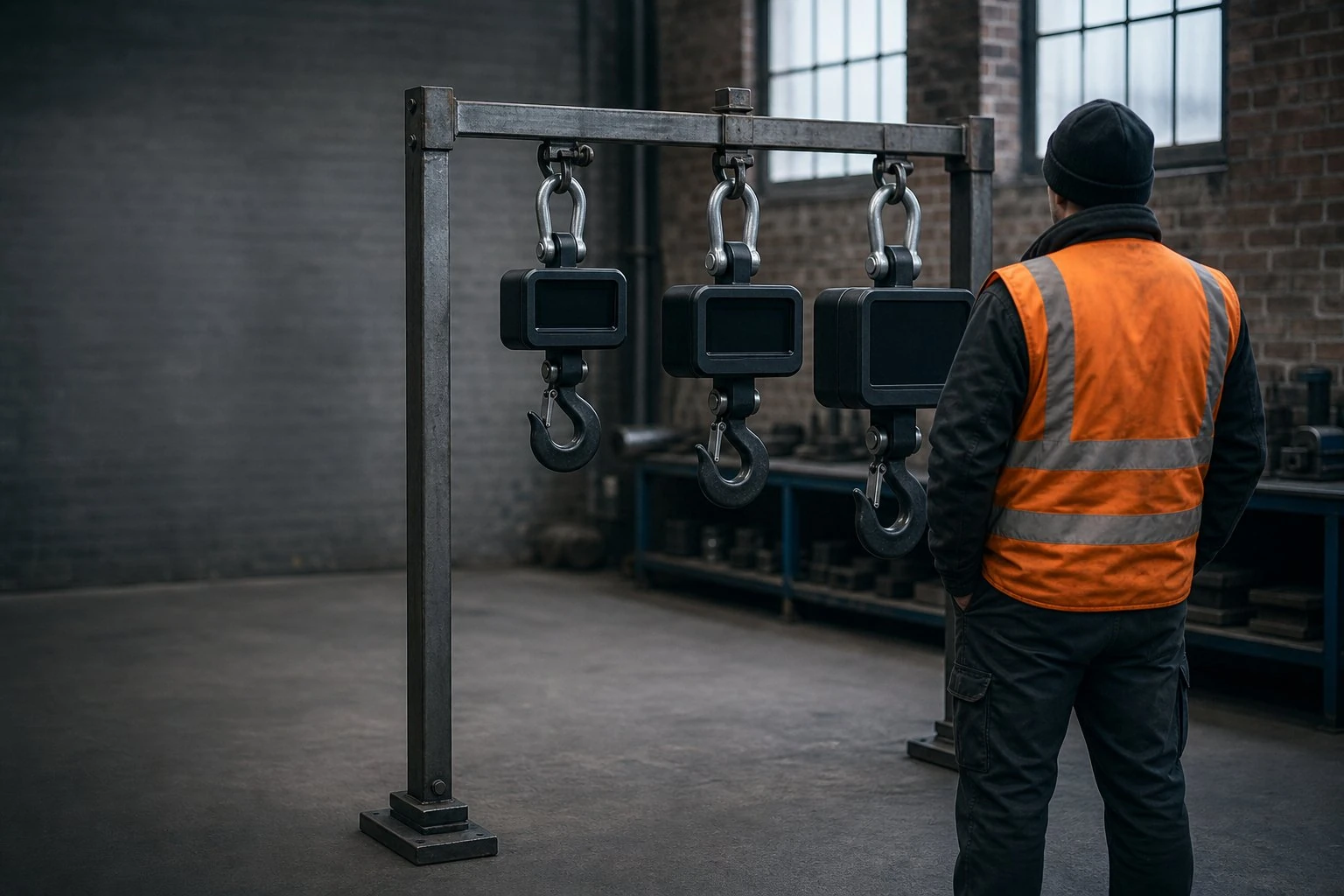
Choosing a 3 tonne crane scale comes down to five questions: how much headroom your heaviest lift needs, what resolution your records require, whether the scale will be used for pricing goods by weight (which changes the legal position entirely), how long the battery must last between charges, and whether the operator can stand clear while reading it. Answer those and the shortlist mostly picks itself.
This guide works through each question, then applies them to the three environments that buy 3-tonne scales most often — scrap and recycling yards, farms, and fabrication workshops — because the right answer shifts with the environment.
Question 1: capacity — and why 3 tonnes suits loads up to about 2.5
Rule of thumb from lifting practice: size the scale so routine loads sit between 20% and 80% of capacity. Below 20%, resolution wastes; above 80%, you have no margin for load estimation error or dynamic spikes when the load starts moving. A 3,000 kg scale is therefore the right tool for loads that peak around 2,400–2,500 kg: a grab-load of mixed scrap steel, an IBC of liquid at around a tonne, engine-and-gearbox assemblies, steel stock bundles, or a big round bale run of feed sacks on a spreader bar.
If your heaviest regular lift already touches 2,800 kg, buy a 5-tonne scale. Never plan to run a scale at its ceiling — the marked capacity is a limit, and our safe use guide explains why the 4:1 ultimate safety factor built into industrial scales is a crash margin, not spare capacity.
Question 2: resolution and what ±1 kg actually means
Resolution is the smallest step the display shows; accuracy is how close the reading sits to true weight. A typical 3-tonne industrial scale reads in 1 kg steps with ±1 kg accuracy — that is 0.033% of full scale, tight enough for stock control, goods-in checking, load verification before transport, and internal batch records. Premium brands offer 0.5 kg resolution at this capacity: Adam Equipment’s IHS 3 reads in 0.5 kg steps, at roughly three times the price. Whether that doubling of resolution is worth £400+ extra depends entirely on use: weighing fabricated assemblies for dispatch paperwork does not need it; formulation work or parts counting might. Our comparison page puts the published numbers side by side so you can judge.
Question 3: the legal line — internal weighing versus selling by weight
This is the question that eliminates options fastest, and most buying guides skip it. UK law (the Weights and Measures Act 1985 framework and the Non-Automatic Weighing Instruments Regulations 2016) requires that any scale used to determine the price of goods in a transaction — buying scrap from the public, selling produce by the kilo — must be Trade Approved (Class III verified). Using a non-approved scale for pricing is a criminal offence enforceable by Trading Standards.
A standard industrial crane scale, ours included, is not Trade Approved. What it is for: internal stock-taking, goods-in verification, checking loads against vehicle payload or crane capacity, dispatch records, process weighing. What it is not for: putting a price on metal you are buying or selling by that reading. A scrap yard therefore typically runs both — a Trade Approved weighbridge or platform scale at the pricing point, and hanging scales in the yard for sorting and logistics, where speed matters and no money changes hands on the number. Details for that setup are in our scrap and recycling industry page.
[LEGAL-CHECK: “非 trade approved 秤不得用于按重量计价交易”的适用边界(B2B 之间以其他单据定价、仅参考称重的情形)建议由合规顾问确认后再收紧或放宽措辞。]
Question 4: power, environment and the details that decide daily usability
- Battery. Look for a rechargeable pack with a stated working duration and a UK charger in the box. Our 3-tonne model runs a 6V rechargeable pack; premium units quote up to 150 hours per charge. Whatever you buy, the practical rule is the same: charge on a schedule, not when it dies mid-lift.
- Display. 30 mm LED digits are the workable minimum for reading at a safe distance outdoors; LCD without backlight struggles in low winter light.
- Remote control. Not a luxury. Zero, tare and hold from a distance keep the operator out of the exclusion zone — a safety function dressed as a convenience feature.
- Housing. Aluminium alloy bodies keep a 3-tonne scale to a one-person carry (ours weighs in as a manageable single-hand unit; die-cast steel-bodied premium units run 12 kg+). Heavier housing takes more abuse; lighter housing gets repositioned more willingly. Match to how often the scale moves.
- Temperature range. -10°C to 40°C covers UK outdoor work including frosty mornings — check this line if the scale lives outside; see our winter weighing notes.
Question 5: paperwork — the part procurement actually blocks on
If a purchase needs sign-off, three documents unblock it: CE/UKCA conformity (legally required for supply in GB), a VAT invoice (we supply one automatically; our VAT registration is displayed on the site), and — for quality systems — a calibration certificate. Traceable calibration for a crane scale runs from about £65 + VAT in the UK aftermarket and can be arranged on request; see our calibration and accuracy explainer for when traceable suffices and when UKAS is worth it. Remember the separate LOLER duty too: once the scale is in service, it joins your lifting-gear examination cycle — the LOLER compliance guide has the register template.
Applying it: three environments, three emphases
Scrap and recycling yards weigh constantly, outdoors, with dirty gloves. Priorities: housing toughness, remote control, battery duration, big display. Resolution beyond 1 kg is irrelevant — nobody prices mixed steel to the half-kilo on a hanging scale (and legally they must not price on it at all; the weighbridge does that). Budget note: at scrap-yard duty cycles, a £274 scale that survives two years beats a £900 scale you hesitate to leave in the yard.
Farms weigh in batches: feed bags, seed, fertiliser IBCs, bale checks against trailer limits. The scale often shares time between barns, so weight and one-person handling matter. One honest caution — hanging scales suit dead loads; live animals need proper platform or crush-mounted systems, not suspension. For bulk-bag work a 3-tonne capacity gives comfortable headroom over the common 1-tonne tote.
Fabrication and maintenance workshops weigh assemblies for dispatch documents and crane-limit checks. Here resolution and records matter most: ±1 kg on a 400 kg weldment is well within what a delivery note needs, and the hold function plus a written log covers traceability. If your QMS demands certificated readings, budget the traceable calibration line item from day one.
Ready to specify? The full data for our 3-tonne model — capacity, resolution, safety factor, battery, temperature range, conformity — is on the product specification page, and multi-unit buyers can get trade terms through the quote request page.
Ready to try CraneScale?
Shop Now — £274.48