Overhead Crane Scales Explained: A UK Buyer's Guide
In heavy industry, precision and safety are not merely goals; they are non-negotiable requirements. For UK businesses operating in logistics, scrap metal, and manufacturing, overhead crane scales serve as the critical interface between hardware and data. Whether you are managing a busy warehouse in Manchester or a construction site in London, understanding how to integrate these high-capacity weighing instruments into your workflow is essential for both regulatory compliance and operational efficiency.
Key Takeaways
- Compliance: Overhead crane scales must meet UK health and safety standards, including the Lifting Operations and Lifting Equipment Regulations (LOLER) 1998.
- Durability: Look for aviation-grade aluminium alloy bodies to ensure longevity in harsh industrial environments.
- Accuracy: Digital readouts with "Hold" functions are vital for recording weights when the load is suspended.
- Capacity: A 3,000kg (3T) capacity is the industry standard for versatile, heavy-duty applications.
At Cranex, our technical team has spent years testing and refining weighing solutions specifically for demanding UK workloads. We've seen firsthand how the right overhead crane scales can transform a business from one that "estimates" to one that "knows," saving thousands in potential fines and lost productivity.
The Role of Overhead Crane Scales in UK Industry
Overhead crane scales are specialized weighing instruments designed to be suspended from a crane hook or hoist. Unlike floor scales, which require the load to be moved to a specific location, crane scales allow for "weighing on the wing." This means the material is weighed while it is being moved, significantly reducing handling time.
In the UK, the use of these scales is strictly governed. According to HSE guidelines under LOLER, any equipment used for lifting must be fit for purpose and subject to statutory periodic examinations. Our 3T Crane Scale Smart Heavy Type is engineered to meet these rigorous demands, utilizing aviation-grade aluminium for a high strength-to-weight ratio.
Why Precision Matters
Precision isn't just about getting the numbers right; it's about safety. Overloading a crane can lead to catastrophic structural failure. In fact, UK HSE data suggests that a significant percentage of lifting accidents are related to equipment failure or overloading. By using accurate overhead crane scales, operators receive real-time data on the load, ensuring it stays within the Safe Working Load (SWL) limits of the lifting gear.
Technical Specifications: What to Look For
When selecting overhead crane scales, UK buyers often get bogged down in jargon. To simplify the process, we have identified the four most critical technical specifications that impact daily performance.
1. Housing Material and IP Rating
The British climate is notoriously unpredictable. Scales used in shipyards or outdoor construction sites must be able to withstand moisture and dust. We recommend scales housed in powder-coated aluminium alloy. This material resists corrosion much better than standard steel while remaining light enough to be portable. For more on the durability of different materials, see The Ultimate Guide to Digital Hanging Scale in the UK.
2. Digital Display and Readability
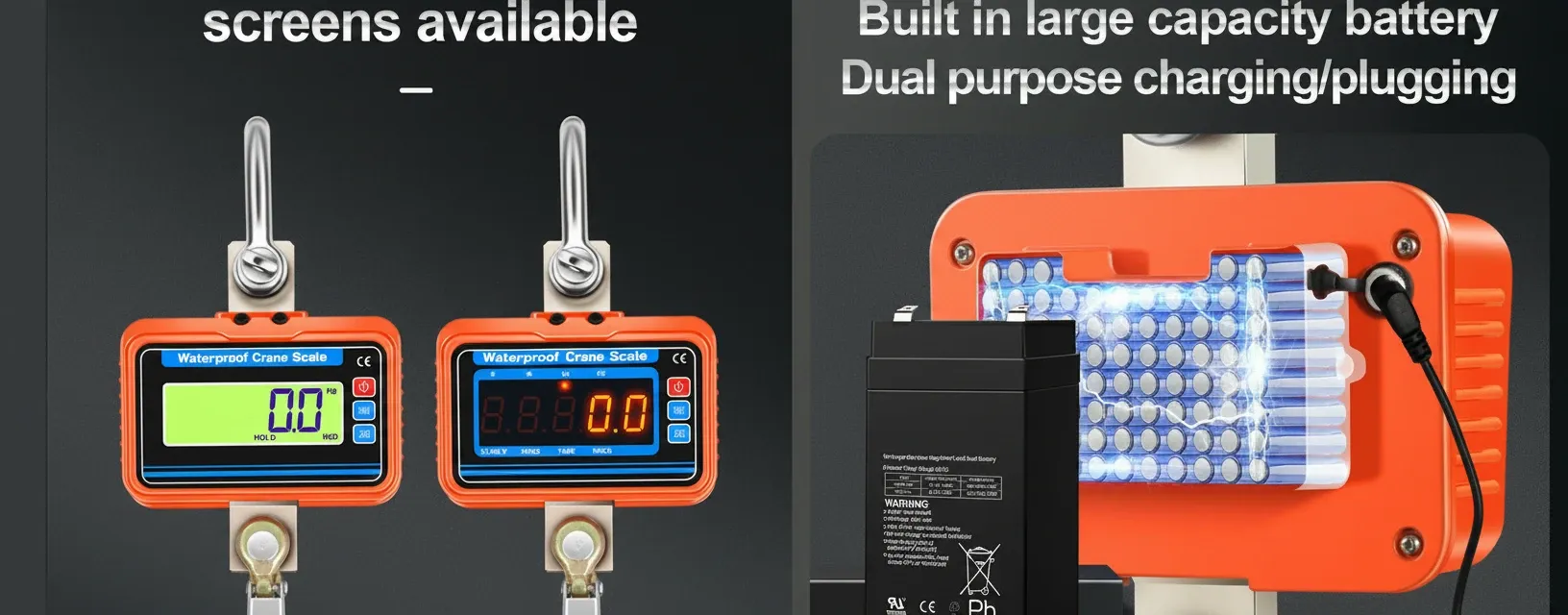
Visibility is a major safety factor. In a dimly lit factory, a small LCD screen is insufficient. Our 3T Smart Heavy Type features a high-brightness LED display with large digits. This ensures that the operator can read the weight from a safe distance, often up to 15-20 metres away, preventing them from standing directly under a suspended load.
3. Battery Life and Power Management
In a high-volume environment, you cannot afford for your scale to die mid-shift. Modern overhead crane scales should offer at least 60-100 hours of continuous use. Look for "Auto-off" and "Idle" modes that preserve battery life during downtime. Our internal testing shows that smart power management can extend battery cycles by up to 40%.
4. Remote Control Functionality
Managing a 3-tonne load requires your hands to be free or on the crane controls. A wireless remote control allows the user to Tare the scale or Zero the readout from a distance. This is a standard feature on our premium models, such as the Crane Scales Explained: A UK Buyer's Guide range, providing an extra layer of operational safety.
Overhead Crane Scales vs. Traditional Floor Scales
A common question we receive at the Cranex technical desk is whether a business should invest in a floor scale or an overhead solution. The answer depends on your workflow. If you are handling large, awkwardly shaped items—such as steel beams, engine blocks, or timber—overhead crane scales are vastly superior.
"Using a crane scale reduced our loading time by 22 minutes per lorry. Over a month, that equated to an extra 15 deliveries we could process without increasing staff hours." — UK Logistics Manager, West Midlands.
Traditional floor scales require the load to be lowered, unhooked, weighed, re-hooked, and lifted again. With overhead crane scales, the weighing occurs during the lift. For a detailed breakdown of how this affects your bottom line, refer to our article on Crane Scale Explained: A UK Buyer's Guide.
UK Regulatory Compliance and Calibration
In the UK, if you are selling goods by weight, your scale must be "Trade Approved." However, even for non-trade applications (internal inventory, safety checks), regular calibration is vital. We recommend a professional calibration check every 6 to 12 months, depending on usage frequency.
Under the Consumer Rights Act 2015, businesses have a right to expect equipment that is fit for purpose. This is why we focus on robust builds. A cheap, plastic-housed scale may save £20 upfront, but it will likely fail a LOLER inspection or break under the strain of a 2-tonne lift, leading to costly replacements and downtime.
The Cranex Advantage: 3T Smart Heavy Type
We have engineered our flagship 3T Crane Scale to be the workhorse of the UK industrial sector. Priced competitively at approximately £110, it bridges the gap between hobbyist tools and prohibitively expensive laboratory equipment.
- Material: Aviation-grade aluminium alloy for maximum impact resistance.
- Capacity: 3,000kg with 1kg increments for high-resolution weighing.
- Safety: Overload alarm system that triggers at 110% of capacity.
- Ease of Use: Simple "Plug and Play" setup with UK-standard power adapters.
Whether you're in agriculture, automotive, or scrap metal processing, this scale is designed to handle the grit and grime of a British workshop.
Ready to Upgrade Your Weighing Precision?
Don't settle for "near enough." Ensure your lifts are safe, accurate, and compliant with the best overhead crane scales in the UK.
Frequently Asked Questions
How often should I calibrate my overhead crane scale?
For most UK industrial environments, we recommend annual calibration by a certified professional. However, if the scale is used daily for heavy loads or in extreme temperatures, a six-monthly check is advisable to ent remains within its stated accuracy tolerances.
Can these scales be used outdoors in the rain?
While many overhead crane scales, including our 3T model, feature moisture-resistant aluminium housings, they should not be submerged or left out in torrential rain for extended periods. We recommend using them under cover when possible or drying them thoroughly after use in damp conditions.
What is the difference between a "hanging scale" and a "crane scale"?
Generally, the terms are used interchangeably, but "crane scale" usually refers to higher-capacity industrial units (1,000kg and above) with heavy-duty shackles, whereas "hanging scale" often refers to lower-capacity units used in retail or light industry. You can learn more in The Ultimate Guide to Digital Hanging Scale in the UK.
What happens if I exceed the weight limit?
Our scales are equipped with an overload warning. If you exceed 110% of the rated capacity (e.g., 3,300kg on a 3T scale), the display will flash a warning. You should immediately lower the load. Exceeding the capacity risks permanent damage to the load cell and compromises safety.
Ready to try CraneScale?
Shop Now — £19.99