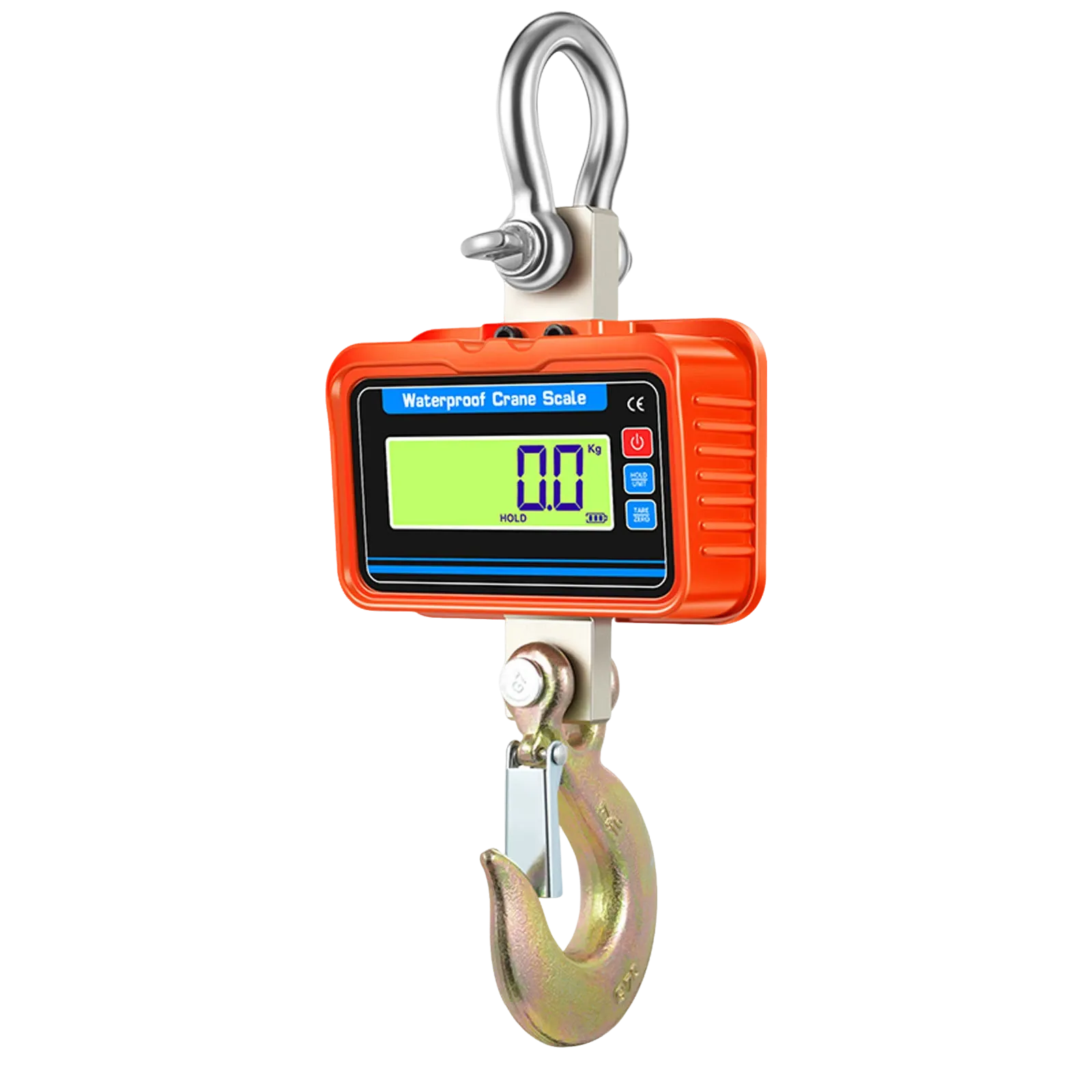
Digital Hanging Scales: A UK Buyer's Guide
Short answer: A digital hanging scale measures a freely suspended item with an electronic load cell and shows the result on a digital display. Choose the product class first: handheld scales suit lighter portable tasks, while industrial crane-scale systems need rated load-bearing fittings, documented capacity and the correct safety and legal evidence. Never assume a luggage or fishing scale is suitable as part of a lifting operation.
Start with product class, not capacity
“Hanging scale”, “hook scale” and “crane scale” overlap in retail listings, but they do not guarantee the same intended use. A higher maximum reading does not by itself turn a handheld instrument into load-bearing lifting equipment. Classify the application before comparing numbers.
| Class | Typical decision | Evidence to require | Do not assume |
|---|---|---|---|
| Handheld or light-duty hanging scale | Portable weighing of luggage, fish, produce, parcels or similar items outside a crane lifting assembly. | Exact Max, display interval, stated use, hook arrangement, power and operating limits. | That a hook, metal case or large number on the display makes it suitable for a crane or hoist. |
| Portable industrial hanging scale | Goods-in, workshop or process checks where the manufacturer documents an industrial suspended-weighing use. | Manual, dimensions, fittings, metrological fields, environment, calibration options and approval status. | That “industrial” proves legal-for-trade status, outdoor use or compatibility with lifting equipment. |
| Industrial crane scale | Suspended weighing in a crane or hoist context, subject to the manufacturer's intended use and the whole lifting system. | Rated load-bearing fittings, SWL information where applicable, drawings, instructions, conformity documents and examination arrangements. | That weighing capacity, SWL, proof load and ultimate load are interchangeable. |
| Load link or digital dynamometer | Force or load measurement between rated shackles, often where a separate handheld display or data output is useful. | Force units, shackle compatibility, load path, calibration, proof-test scope, display architecture and intended-use evidence. | That a peak force is the same as static mass or that any link fits any rigging arrangement. |
| Integrated crane weighing system | A fixed sensor, load pin or system-level installation where headroom, crane geometry, controls and data integration matter. | Project-specific engineering, installation drawings, system calibration and competent commissioning. | That a detachable scale and an integrated sensor are direct substitutes. |
If the instrument will become part of a bridge, gantry, jib or hoist installation, use the separate overhead crane scale setup guide for headroom, fittings and remote-display architecture. For broader industrial category selection, compare industrial crane scales by capacity, physical fit and compliance evidence.
Four source-checked examples show why the fields matter
The examples below are not rankings or recommendations. They show the span of current manufacturer-defined classes and, importantly, how a useful source separates Max, minimum load, display division and performance. No specification from one model should be transferred to another.
| Class and exact source | Fields stated on that source | What the example teaches | Boundary |
|---|---|---|---|
| Light: KERN CH 50K50 Manufacturer product page | 50 kg Max; 0.05 kg actual scale interval; 0.05 kg reproducibility; ±0.1 kg linearity; 5–35 °C stated ambient range. | A 50 g display step is not the same statement as linearity, and a light hanging-scale page can still provide separate performance fields. | The example does not grant another handheld scale crane compatibility or the same performance. |
| Portable industrial: Marsden OCS-L Manufacturer product page | The structured variant list covers 30, 50, 150 and 300 kg with 0.01, 0.02, 0.05 and 0.1 kg graduations; the page labels the range non-approved. | Capacity and graduation change together by variant, while approval status is a separate field. | The page contains inconsistent narrative range wording, so only the structured variants are repeated here. |
| 1–3 tonne: KERN HFD 3T-3M Manufacturer product page | 3,000 kg Max; 20 kg verifiable Min; 1 kg d; 1 kg e; 1 kg reproducibility; ±1 kg linearity; optional conformity assessment at order. | Max, Min, actual division, verification interval and linearity are distinct, even when some values happen to be numerically equal. | The optional assessment is model- and order-specific; it does not approve every HFD or any other scale. |
| 10 tonne plus: KERN HFD 10T-3M Manufacturer product page | 12,000 kg Max; 100 kg Min; 5 kg d; 5 kg e; 5 kg reproducibility; ±5 kg linearity; optional conformity assessment at order. | Higher capacity commonly brings a coarser display interval and a materially higher documented minimum load. | Do not use the model below Min or infer suitability for a lift from weighing fields alone. |
How a digital hanging scale produces a reading
- Load path: the suspended item applies force through the instrument's load receptor and load-bearing structure.
- Load cell: the transducer converts force into an electrical output. A digital instrument remains a force-measurement system even when it reports kilograms.
- Signal chain: amplification, analogue-to-digital conversion and processing turn the output into a usable indication.
- Calibration relationship: stored coefficients relate signal to indicated mass under defined conditions. That relationship can change with loading history, movement, temperature, position and other influences.
- Display or data output: the indicator shows a rounded mass value, while a remote repeater or data interface may carry the result elsewhere.
OIML R 76-1 defines an indicator as the device that can convert and process the load-cell output and display a mass result. It also defines the actual scale interval d as the difference between consecutive indicated values. Those definitions explain the electronic chain, but they do not certify a particular model.
Digital versus mechanical
A digital display can avoid reading a pointer between marks and may add tare, hold, filtering or data functions. A mechanical instrument can avoid batteries and may make its operating principle easier to inspect. Neither technology is automatically more accurate. Compare the exact model's error, repeatability, hysteresis, uncertainty, environment and calibration evidence at the loads you need.
Capacity, resolution, accuracy and verification are different
| Term | What it tells you | What it does not tell you |
|---|---|---|
| Maximum capacity, Max | The upper weighing capacity stated for the instrument. | It is not automatically the SWL of the complete lifting system, a proof load or an ultimate load. |
| Minimum capacity, Min | The load below which relative error may be excessive; OIML defines Min on this basis. | It is not the smallest change the display can show. |
| Actual scale interval, d | The difference between consecutive digital indications: readability or display division. | It is not an accuracy tolerance and should not be rewritten as “±d accuracy”. |
| Verification scale interval, e | The interval used to classify and verify a regulated instrument. | It need not answer every process-uncertainty question. |
| Repeatability and linearity | Repeatability addresses variation under repeated conditions; linearity describes deviation across the range. | Neither alone is a complete uncertainty statement. |
| Calibration | A documented determination of metrological values under stated conditions, with results and uncertainty where applicable. | It is not adjustment, a LOLER examination or legal verification. |
| Legal verification or conformity assessment | Evidence that the exact instrument has followed the applicable legal-metrology route for a regulated purpose. | It is not supplied merely by a calibration certificate or a generic CE/UKCA logo. |
| SWL and lifting evidence | The safe limit and supporting evidence for equipment used in the lifting arrangement. | It is not a metrological accuracy field. |
Choose capacity from the heaviest planned load, the instrument and accessory weights that the lift plan must account for, the crane's permitted configuration and every component's documented safe limit. HSE says lifting accessories between the lifting equipment and load may need to be included in the overall load, and that safe limits must not be exceeded (Safe lifting by machine). There is no universal percentage margin that this article can prescribe.
At the low end of a large-capacity instrument, relative uncertainty can be unsuitable even though the display still produces numbers. UKAS LAB 14, Edition 8 notes that relative measurement uncertainty increases towards the lower end of a range and that a smaller-capacity instrument with better resolution may be more appropriate. LAB 14 is laboratory guidance, not a universal approval for every workplace scale.
Why a stable suspended reading is difficult
A load cell reacts to force. Swing, rotation, acceleration, shock loading, contact with another object and a changing load path can all alter the force reaching it. A motion filter can smooth or delay the displayed value, but it cannot prove that a moving indication equals static mass.
UKAS identifies movement, vibration, temperature and electromagnetic influences as possible causes of instability or consistent indication error. Its guidance also describes dynamic overshoot when a load comes to rest. For a hanging scale, the safe response is not an invented settling-time rule: follow the exact manual's stable indication and the competent lift plan, and never prolong a suspended-load exposure merely to obtain a reading.
- Prevent side loading, twisting and contact only in the manner required by the manufacturer and lift plan.
- Do not use hold to hide an unstable indication.
- Do not interpret peak hold as ordinary static mass unless the documented method specifically requires that measurement.
- If the reading is unexpected, treat that as a reason to stop and investigate under the site's procedure, not to repeat an improvised lift.
Tare, hold, peak hold and data functions
| Function | Useful purpose | Important limit |
|---|---|---|
| Zero | Establishes the unloaded reference within the instrument's permitted zero range. | It does not correct drift, damage or an unsuitable installation. |
| Tare | Subtracts a container, sling or other reference so the display can show a net value. | Tare does not remove physical load or increase Max, SWL or remaining structural capacity. |
| Hold or data hold | Freezes an indicated value so it can be read or recorded. | A frozen value is not automatically stable, accurate or traceable. |
| Peak hold | Records the highest indicated force or value during a defined event. | It is not a substitute for static weighing and may depend on sample rate and filtering. |
| Motion filter | Changes how the indicator responds to fluctuating signals. | More smoothing can add delay and cannot remove the physical cause of motion. |
| Remote control | Sends commands such as tare, zero or hold where the manual permits. | It is not the same as a remote display and does not define a safe operator position. |
| Remote display or data output | Receives weight data for viewing, logging or integration. | Confirm range, update rate, fail-state, units, timestamps and whether stored data are legally usable. |
Display, power and environment checks
Display and controls
Check digit height, contrast, viewing angle, glare, low-temperature behaviour and the actual reading distance in the installation. An LCD may be power-efficient; an LED may be more conspicuous in some conditions. Neither is universally better. If operators cannot approach the indicator, specify a real remote display or data receiver rather than mistaking a command handset for one.
Power
Ask for battery chemistry, capacity, replaceability, charge time, documented runtime and the conditions behind that runtime. Confirm charger input, supplied plug, whether operation while charging is permitted, low-battery behaviour and the effect of cold conditions. “Rechargeable” alone does not answer any of these questions, and auto-off can be inappropriate if it conflicts with the work method.
Ingress, temperature and corrosion
Use an exact complete-device IP code, not words such as waterproof or sealed. BSI's BS EN 60529 summary explains that the IP Code classifies protection against access, solid objects and harmful water ingress and defines tests for those designations. It does not by itself establish corrosion resistance, condensation tolerance, impact resistance, frost performance or marine suitability.
Match the documented temperature and humidity range to the site, including warm-up after storage and condensation during transitions. UKAS notes that temperature, movement and electromagnetic interference can affect electronic weighing indications. In wet, abrasive or corrosive workplaces, HSE says deterioration risk must be considered when selecting and maintaining lifting equipment.
Explosive atmospheres
A standard battery-powered scale must not be assumed suitable for a hazardous area. HSE's DSEAR guidance requires employers to identify and classify areas where explosive atmospheres may occur and avoid ignition sources from unprotected equipment. Require certification and marking for the exact equipment, zone, gas or dust group and temperature class, plus competent site review.
Safe-use boundaries for work lifting
HSE's LOLER overview says lifting operations at work must be properly planned by a competent person, appropriately supervised and carried out safely. Lifting equipment must be fit for purpose, appropriately marked and, in many cases, thoroughly examined. A scale reading is one input; it does not approve a lift, a crane configuration or an attachment method.
- Never attach a consumer or handheld hanging scale to lifting machinery without explicit manufacturer evidence for that use.
- Never exceed the marked safe limits of the crane, scale, shackles, hooks, slings or other accessories.
- Do not lift people with an instrument not specifically designed, marked and managed for that purpose.
- Use only compatible fittings and load paths identified by the manufacturer and competent person; a hook that physically fits is not proof of compatibility.
- Keep people out of danger from a suspended load according to the lift plan; a remote function does not make standing beneath a load acceptable.
- Follow the exact pre-use checks, inspection, maintenance and post-event instructions. This web list is not exhaustive.
UK legal and metrology checks
Calibration is not legal verification
UKAS defines calibration as obtaining metrological values and explicitly distinguishes it from adjustment and verification. A useful calibration certificate identifies the instrument, serial number, conditions, method, load points, as-found and as-left status where applicable, results, uncertainty and traceability. It supports a measurement decision only within its stated scope.
Set the calibration and intermediate-check programme from application risk, required tolerance, use, performance history, movement, environment and manufacturer guidance. LAB 14's interval discussion is scoped to laboratories supporting accredited work; it must not be turned into a universal six- or twelve-month legal rule for every hanging scale.
LOLER thorough examination is not calibration
A LOLER thorough examination is a systematic, detailed examination of safety-critical parts by a competent person, followed by a written report. It addresses continued safety, not weighing error. HSE also says routine load testing is not required at every examination and that some overload tests can damage equipment; the competent person determines the need and method from risk and manufacturer information (Thorough examinations and inspections).
Proof-load evidence has a narrow scope
A proof- or load-test certificate supports only the item, configuration, applied load, method, date and acceptance criterion recorded on it. It does not establish display accuracy, calibration uncertainty, legal-for-trade status or continued safety after later damage or modification. Ask which serialised item and fittings the record covers.
When regulated-purpose rules apply
The GOV.UK guide to the Non-Automatic Weighing Instruments Regulations 2016 lists regulated purposes including commercial transactions, payments or tariffs determined by mass, application of laws, specified medical and pharmaceutical uses, direct-sale pricing and making up prepackages. A regulated non-automatic instrument must follow the applicable conformity-assessment route.
For an exact instrument, check type and serial identification, technical documentation, declaration, applicable CE or UKCA marking, the M marking and verification details. GOV.UK states that the M marking remains required for regulated instruments whether CE or UKCA is used. A generic conformity logo or a calibration sticker alone is not enough.
A practical decision route
- Define the purpose: portable non-lifting check, industrial suspended process weighing, work lifting, force measurement, or regulated-purpose mass determination.
- Choose the class: handheld, portable industrial, crane scale, load link or integrated system. Reject any product whose intended use is ambiguous.
- Set the measurement need: expected load range, required process tolerance and uncertainty, not simply the smallest display digit.
- Check physical fit: upper and lower fittings, overall length, headroom, self-weight, load path and every component's safe limit.
- Check operation: stable-reading method, display location, remote-control versus remote-display needs, data capture and power behaviour.
- Check environment: complete-device IP, temperature, condensation, corrosion, impact, electromagnetic conditions and hazardous-area status.
- Check evidence: exact manual, drawing, declaration, metrology fields, calibration scope, lifting records and legal verification where required.
- Obtain competent review: for any work lifting or unusual installation, resolve compatibility and duty-holder obligations before purchase or use.
Digital hanging scale FAQ
What is a digital hanging scale?
A digital hanging scale is an electronic instrument that indicates the mass of an item suspended from its load receptor. A load cell converts applied force into a signal, electronics process it and a display shows a mass value. The term covers light handheld devices and industrial equipment, so capacity alone does not establish lifting suitability.
What is the difference between a hanging scale and a crane scale?
A hanging scale is the broad category; a crane scale is an industrial form intended and documented for a crane or hoist context. Retail terminology overlaps, so do not rely on the name or a capacity threshold. Check the manufacturer's intended use, load-bearing fittings, markings, instructions and evidence for the complete lifting arrangement.
Are digital hanging scales more accurate than mechanical scales?
Digital hanging scales are not inherently more accurate than mechanical scales. A digital display can reduce parallax and make small increments easier to read, but accuracy depends on the exact instrument, calibration, repeatability, linearity, uncertainty, loading and environment. Compare documented performance at the loads you will actually measure, not display technology alone.
What do tare, hold and peak hold do?
Tare sets a loaded reference to zero, hold freezes an indicated result, and peak hold records the highest indicated value during an event. These functions do not increase capacity, prove that a reading was stable or replace a calibrated measurement method. Confirm the exact implementation in the model manual before relying on any stored value.
Why does a swinging load change the reading?
A swinging load changes the reading because the load cell responds to force, and acceleration or a changing load path alters that force. Motion filters may steady the display but cannot turn a dynamic event into a known static mass. Follow the manufacturer's stability indication and the competent lift plan; do not freeze a transient value with hold.
Can I use a digital hanging scale outdoors?
You can use a digital hanging scale outdoors only when the exact model documentation permits the expected exposure. Check its complete-device IP code, temperature range, condensation and corrosion limits, battery and display limits, and the tested configuration. An aluminium housing, sealed-looking keypad or the word weatherproof is not evidence of outdoor suitability.
Can any hanging scale be attached to a crane?
No, not every hanging scale can be attached to a crane. A handheld luggage, fishing or light-duty scale must not enter a lifting arrangement unless its manufacturer explicitly documents that intended use, rated load-bearing fittings and applicable conformity. A competent person must also assess compatibility, headroom and the safe limits of the whole system.
When do I need a trade-approved hanging scale in the UK?
You need an appropriately conformity-assessed and verified instrument when mass is determined for a regulated purpose, such as a commercial transaction or another use listed in the UK weighing-instrument rules. Check the exact application, instrument markings and documentation. A calibration certificate, CE or UKCA mark alone does not establish legal-for-trade status.
Sources and evidence date
Legal, safety and metrology statements are linked where they are used. Model examples repeat only fields visible on exact manufacturer pages. Sources were checked on 19 July 2026.
- Health and Safety Executive — LOLER overview, updated 22 January 2026.
- Health and Safety Executive — Safe lifting by machine, updated 19 November 2024.
- Health and Safety Executive — Thorough examinations and inspections of lifting equipment, updated 29 October 2024.
- Health and Safety Executive — DSEAR overview, updated 14 October 2024.
- Office for Product Safety and Standards — Non-Automatic Weighing Instruments Regulations 2016: Great Britain, March 2025.
- UKAS — LAB 14 Guidance on the calibration of weighing machines, Edition 8, December 2025.
- OIML R 76-1 — Non-automatic weighing instruments, terminology for Max, Min, d and e.
- BSI — BS EN 60529 IP Code summary.
- KERN — CH 50K50 manufacturer product page.
- Marsden — OCS-L manufacturer product page.
- KERN — HFD 3T-3M manufacturer product page.
- KERN — HFD 10T-3M manufacturer product page.
Ready to try CraneScale?
Shop Now — £274.48